
Lift stations
A lift station is a wet well with one or more pumps that collects sewage flowing in by gravity from a low area and lifts it through a pressure pipe to a higher sewer line or treatment plant. Utilities run large ones for whole neighborhoods; smaller ones serve a single low house, a cluster of homes on a private road, a condominium or a business.
This page explains what a lift station is and does, how it works, what the parts are called, who owns the stations in Baldwin and Mobile counties, and where residential lift station repair fits. The low-pressure sewer guide covers the network the stations feed.
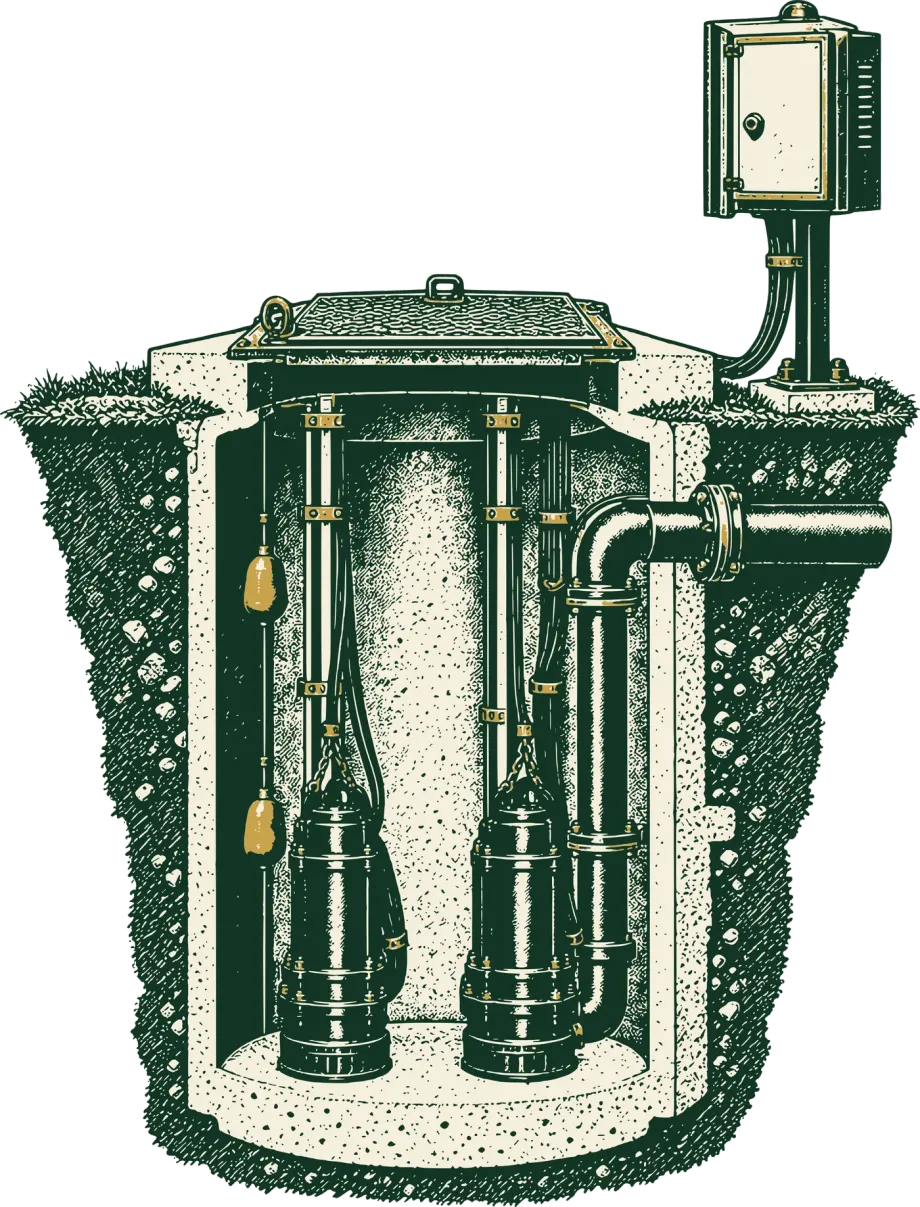
Plate LXVII. Where gravity resigned, two pumps took over.
Start here
- Lift station repairResidential wet wells with one or two pumps: panel and alternator, floats, valve vault check valves, and pumps lifted on their rails without entering the well.
- Low-pressure sewer systems explainedThe network of small pressure pipes that grinder pumps and small lift stations feed, and what each local utility requires on it.
What a lift station does
Sewer pipes run downhill. On flat coastal ground they cannot run downhill forever without ending up far below the surface, so at intervals the flow drops into a wet well and is pumped back up to a shallow pipe or pushed through a force main to the plant. That is a lift station. A pump station is the same thing; the terms are used interchangeably, with lift station more common for sewage and pump station for water. A sanitary lift station handles sewage; a storm lift station handles rainwater and is a different system. A sump pump lifts clean ground water out of a pit and is not a lift station at all.
How a lift station works
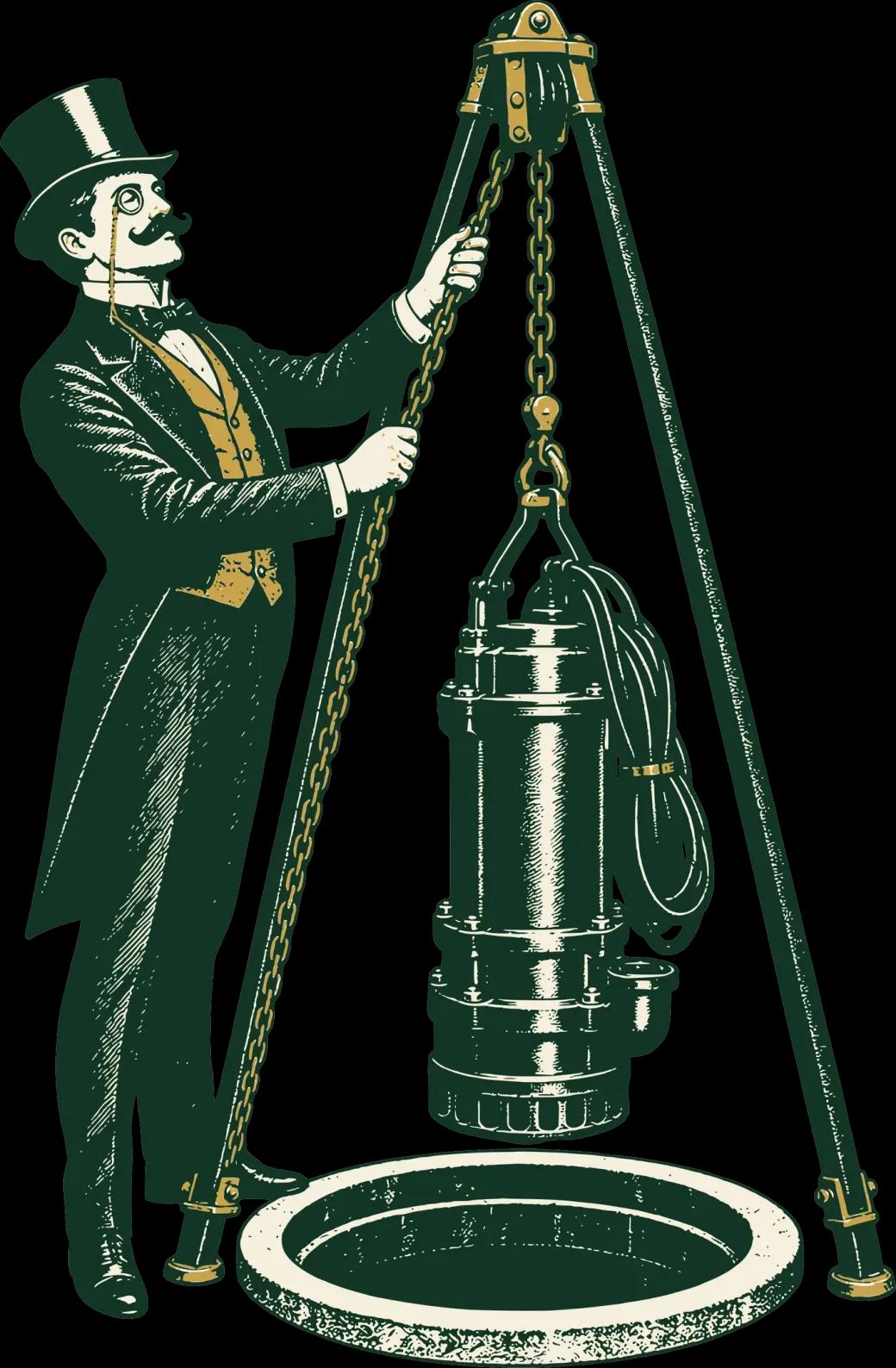
Sewage enters the wet well through the gravity inlet. Floats or a level transducer hang in the well: an off float at the bottom, a lead float that starts the first pump, a lag float that starts the second if the level keeps rising, and an alarm float above that. A duplex station alternates its two pumps on each cycle so they wear evenly, and runs both when inflow is heavy. Each pump sits on a discharge elbow at the bottom of the well and rides guide rails so it can be lifted out from the surface without anyone entering the well; the North Baldwin and Loxley specifications require that. The pumps push into a valve vault beside the well, where each pump has its own check valve and an isolation valve, and from there into the force main. Keen's duplex start-up procedure tests each pump in Hand, confirms alternation in Auto, and proves the override float before the station is put in service.
The control panel carries the alternator, the contactors and overloads for each pump, and the alarm. Liberty's duplex controller, as an example, treats six hours of a closed alarm float with an open primary float as a fault: flashing alarm, pumps off. On battery backup it can sound the alarm but cannot run the pumps. A stand-alone alarm such as the SJE Rhombus Tank Alert XT runs on a separate circuit so it still works if the pump circuit fails.
The parts, by name
These are the words you will hear on a service call.
- Wet wellThe pit that holds the sewage. Dry well: a separate chamber beside it where pumps and valves sit in the dry on some larger stations.
- Submersible pumpA sealed pump that sits in the sewage; residential stations are almost always submersible.
- Guide rails and discharge elbowThe track and seat that let a pump be lifted and reseated from above.
- Floats, transducer and override floatThe level controls that start, stop and alarm.
- Valve vaultThe box beside the well with each pump's check valve and isolation valve.
- Force mainThe pressure pipe leaving the station.
- AlternatorThe panel relay that swaps lead and lag pumps each cycle.
- Generator receptacleA transfer connection for backup power, which Riviera requires on new low-pressure stations in Foley.
Grinder stations and lift stations
In these two counties the small lift stations serving homes are usually grinder stations: E-One's DH152 is a duplex station with two 1 horsepower progressing cavity pumps and a 150 gallon tank, built for up to four homes, or twelve with the factory's consent. Zoeller says not to put a simplex station on more than two homes. Larger utility stations use solids-handling pumps instead; Gulf Shores Utilities' station specification does not accept grinder pumps in the stations it takes over, specifies pumps from three named makers, and requires a drawdown test at start-up. Which type you have decides what clogs it and what pump replaces it.
Who owns the lift stations here
Utility stations belong to the utility: BCSS's standard specifications have developers convey lift stations, pumps and valves to BCSS by bill of sale, with an inspection in the eleventh month before the maintenance bond expires, and Gulf Shores Utilities takes over stations built to its Section VII specification. A private station on a home's lot, or shared by a few homes on a private road, belongs to the owners the same way a grinder pump does on an owner-maintained sewer system. A handful of private wastewater systems in Mobile County, Dawes Creek I and II, Magnolia Crest, McConnell Interchange Business Park and Mockingbird Hill Estate, are regulated by the Alabama Public Service Commission and own their own stations. If the panel in your yard serves only your house or your short road, it is probably yours; if it serves the subdivision, it probably is not.
Questions people ask
What is the difference between a lift station and a pump station?
Nothing, in practice. Lift station is the usual term for a sewage station that lifts flow from a low gravity line; pump station is used for the same thing and also for water and stormwater. A sewage pump station and a sewage lift station are the same structure.
What is a lift station used for?
Keeping gravity sewers shallow. Each time a sewer line gets too deep, a lift station raises the flow back up, or pushes it through a force main toward the treatment plant. Small ones do the same for a single low property.
What is the difference between a lift station and a sump pump?
A sump pump moves clean ground water out of a pit under a floor and must not be connected to the sewer. A lift station moves sewage. Different pumps, different pipes, different rules.
Does a lift station need a generator?
Without power the pumps stop and the well fills. Riviera requires a generator receptacle with a manual transfer breaker on new low-pressure stations in Foley, E-One offers a generator receptacle with automatic transfer on its panels, and BCSS lists a 6,500 watt running generator as the minimum for its Keen stations. For a home station that serves only you, a receptacle and a portable generator is the usual answer.
Who do I call when a lift station alarm goes off?
For a subdivision station, call its utility or operator. For a shared private station, contact whoever maintains it. For a single-home station, stop using water and request residential repair. Keep the hatch and valve vault closed.
Sources and facts
- NBU and Loxley: pump removable without entering the well. North Baldwin Utilities, Specifications for Utility Infrastructure (effective 2021-09-17), www.northbaldwinutilities.com/…; City of Loxley, Water and Sewer Standard Specifications (March 2019, Sec. 2.5), www.cityofloxley.com/… (read 2026-11-04)
- Keen duplex start-up and test cycle: H-O-A switch per pump, alternation, override float. Keen Pump O&M-KGPGRINDER (duplex start-up and test cycle), keenpump.com/… (read 2026-11-04)
- Liberty PDC duplex controller: alarm float closed 6 hours with primary float open gives a flashing alarm and pumps off; on battery backup it alarms but cannot run pumps. Liberty Pumps PDC-Series duplex controller installation manual, www.pumpproducts.com/… (read 2026-11-04)
- SJE Rhombus Tank Alert XT works on a separate circuit if the pump circuit fails. SJE Rhombus Tank Alert XT product page, www.sjerhombus.com/products/tank-alert-xt (read 2026-11-04)
- Riviera requires a generator receptacle with a manual transfer breaker. Riviera Utilities, Sewer Policy Handbook sections 7.3-7.4 (file dated 2024-05), www.rivierautilities.com/… (read 2026-11-04)
- E-One DH152: duplex, two 1 hp pumps, 150 gal, up to four homes or twelve with factory consent. Zoeller: no simplex station on more than two homes. E/One DH152 Drawings (NA0052P01 Rev F), eone.com/… p.1-2; Zoeller FM2167 Owner's Manual, Models 818 and 820 Submersible Grinder Units, zoellerpumps.com/… p.2 (read 2026-11-04)
- Gulf Shores Utilities Section VII: station pumps from Wilo, Flygt or Sulzer; grinder pumps not acceptable in stations; drawdown test at start-up. Gulf Shores Utilities, Section VII Submersible Pump Stations spec, www.gulfshoresutilities.com/specs7 (read 2026-11-04)
- BCSS Standard Specifications: developers convey lift stations, pumps and valves to BCSS by bill of sale; eleven-month inspection before the maintenance bond expires. BCSS Standard Specifications (October 2020), www.baldwincountysewer.com/… (read 2026-11-04)
- Alabama PSC private wastewater systems in Mobile County: Dawes Creek I and II, Magnolia Crest Subdivision, McConnell Interchange Business Park, Mockingbird Hill Estate. Alabama Public Service Commission, wastewater management entities list (as of 2026-03-31), psc.alabama.gov/… (read 2026-11-04)
- E-One optional 20 A 250 VAC generator receptacle with automatic transfer; BCSS Keen station minimum generator 6,500 W running. E/One D-Series Semi-Positive Displacement Type Grinder Pump Stations specification, eone.com/images/files/d-series-spec.pdf p.9; BCSS-distributed Grinder Station User Guide (Keen KPCGSL21 station with generator connection), www.baldwincountysewer.com/… p.7 (read 2026-11-04)
Need a gentleman at the pump?
Tell us what the panel is doing and where you are. We reply with the next safe step and a visit time.